



















The following article contains spoilers for Guillermo del Toro’s Frankenstein on Netflix. Reader discretion is advised.
Guillermo del Toro’s reimagined Frankenstein hit Netflix last month on November 7th, bringing with it a flurry of horror and gothic flair. It is distinctly Frankensteinian, but make no mistake, this movie has made some major changes to the plot of Mary Shelley’s famous 1818 novel.
As a fan of the original Frankenstein, which has a clever alternate title of The Modern Prometheus, I was thrilled to hear that a director such as del Toro had chosen the sci-fi sensation for a film adaptation. Despite not being familiar with his work, I’d always heard high praise for his films, and was immediately interested in how he would shape the story.
I’ll admit, the costuming put me off somewhat. Otherworldly, with vibrant colors and unusual accessories, it didn’t feel like the dreary vibe Shelley had created on a stormy night. But this is exactly what makes the characters stand out against their surroundings, and paired with seeing the characters in action, it makes perfect sense.
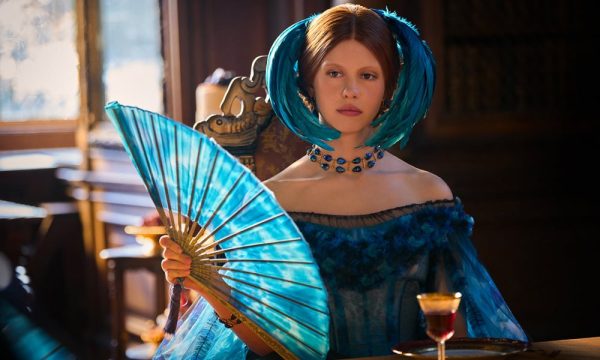
Mia Goth’s Elizabeth Lavenza – rewritten here as Elizabeth Harlander, the niece of Frankenstein’s investor Heinrich Harlander – is ethereal and alien. Suddenly, her feather hairpieces and extravagant dresses make sense as she chases butterflies in a field and becomes the very meaning of quiet beauty. Against the muted colors that, for the most part, are the film’s background, Elizabeth stands out as both the apple of Frankenstein’s eye and as a self-made woman, resistant to Frankenstein’s moves on her.
Goth’s costume draws plenty of attention, but it’s her acting that made me fall in love with Elizabeth as a character. Elizabeth is full of fascination and a love of the natural world, but she’s far from childish. In fact, she exhibits far better restraint and emotional control than Frankenstein, who is prone to fits of passion. Elizabeth has devoted herself to making the best of what already is (in multiple ways, including her arranged marriage to Frankenstein’s brother William) instead of reaching for something that may disrupt the natural order. Where Frankenstein drives himself to ostracization and destruction, Elizabeth embraces the birth of new wonders as they arrive. In her world, what is meant to be, will be.
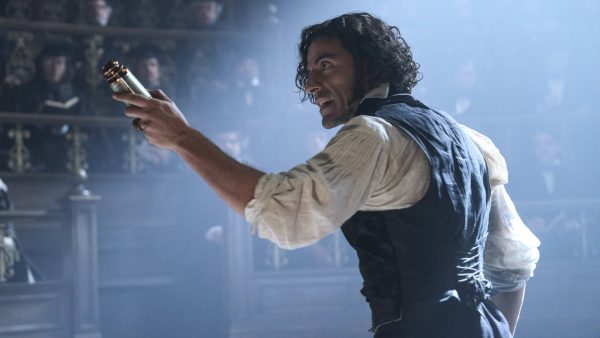
Victor Frankenstein himself, played by Oscar Isaac, is a spectacular comparison to Prometheus in this film. His dreams are surrounded by flame and he’s haunted by the Angel of Death, who fuels his determination to avoid death entirely and create immortality for the human race. He is driven by a desire to change fate itself, and Isaac’s Frankenstein is a balanced mix of raving lunatic and unmatched genius. When he is scorned by the public and approached by Heinrich Harlander, Frankenstein isolates himself in an abandoned water tower, making his laboratory at its top; if anything, it’s a recession into his own mind at the head of the tower.
Isaac’s appearance is also key to characterizing Frankenstein. A scowling mug brings to mind a scientist who has never once been taken seriously, and makes him seem less than up for the parenting his creation will require once he succeeds in his experiments, which launch the story’s main conflict: a son searching for his father and trying to understand why he was brought into the world the way he was.
In this regard, Jacob Elordi’s Creature – also affectionately referred to as Adam by fans – is nothing short of stunning. From Adam’s first waking moments and curious, childlike beginnings to his descent, years later, into the same sort of madness that once consumed Frankenstein, Elordi is able to capture the full force of life itself. Adam is a reckoning, a realization; Elordi embraces every twist and turn as if for the first time. It really brings together the evergreen theme of Adam as Frankenstein’s child, forced to learn the cruelties and virtues of the world on his own.
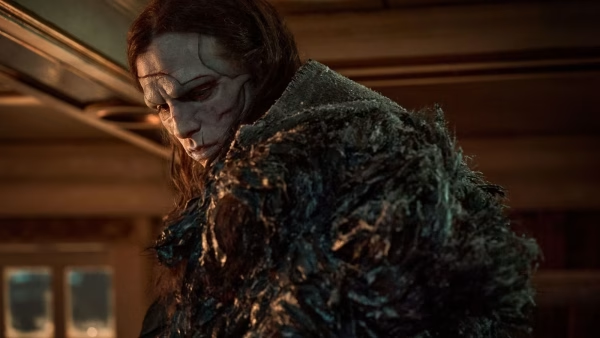
Additionally, can we talk about Adam’s construction? An amalgamation of tissue, be it bone or muscle or nerves, del Toro’s Frankenstein makes him grotesquely beautiful. He mirrors Goth’s Elizabeth, so strange and fantastical in nature, but with a presence that screams reality. The scars from his birth, rippling through his skin, make him both mesmerizing and stomach-churning to watch. In my mind, he’s somewhat like a puppet, ball-jointed and though he’s made in the imitation of man, he’s not quite human. Looking back on the film, I think that leaves space for him to gain humanity where his creator lost it.
There are so many more characters I could go on about: Captain Anderson, Heinrich Harlander, William Frankenstein; even the Frankensteins’ parents, Claire and Leopold Frankenstein. But the costuming and characterization of these three stuck out in particular.
This isn’t to say the rest of the cast is dull by any means; in fact, I wasn’t even upset about the lack of Victor’s best friend, Henry Clerval, in the film (who I suspect has been replaced with Heinrich Harlander). That is just how good the combined forces of scripting, directing, and acting were when brought together for this film. I genuinely enjoyed watching this, and could not tear my eyes away for even a second.
To anyone debating whether or not to watch Guillermo del Toro’s Frankenstein: this is your sign to watch it. And maybe it’ll inspire you to pick up the book, too, which I would also highly recommend!